SolarYieldLab
Solar analytics & digital-twin platform
Architecture
Case Study
The problem
Estimating what a solar installation should produce — and diagnosing why it underperforms — requires combining weather data, irradiance models, panel physics and site specifics. Owners and analysts usually get a single opaque number with no uncertainty attached and no way to compare design alternatives.
The approach
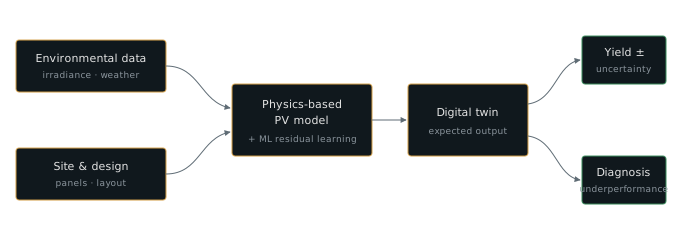
SolarYieldLab is built as a digital twin of a PV installation:
- Multi-source environmental data — irradiance, temperature and weather inputs assembled through automated pipelines, designed to work for any location globally.
- Physics-based PV modelling — a first-principles model of the panel and system produces the expected yield for a given design and climate.
- Machine learning — learns the residual patterns physics alone misses, and supports underperformance diagnosis by comparing observed output against the twin's expectation.
- Uncertainty quantification — every estimate carries an uncertainty band, because a yield prediction without error bars invites bad investment decisions.
The platform supports comparing candidate designs before committing, then monitoring the built system against its twin.
Why it matters
Solar economics are decided on the margin — a few percent of misestimated yield changes whether a project is viable. Pairing physics with ML and honest uncertainty is the difference between an analytics toy and a tool someone could base decisions on.
Status
In active development through 2026. Benchmarks against real installation data will be written up on the blog as the validation work completes.